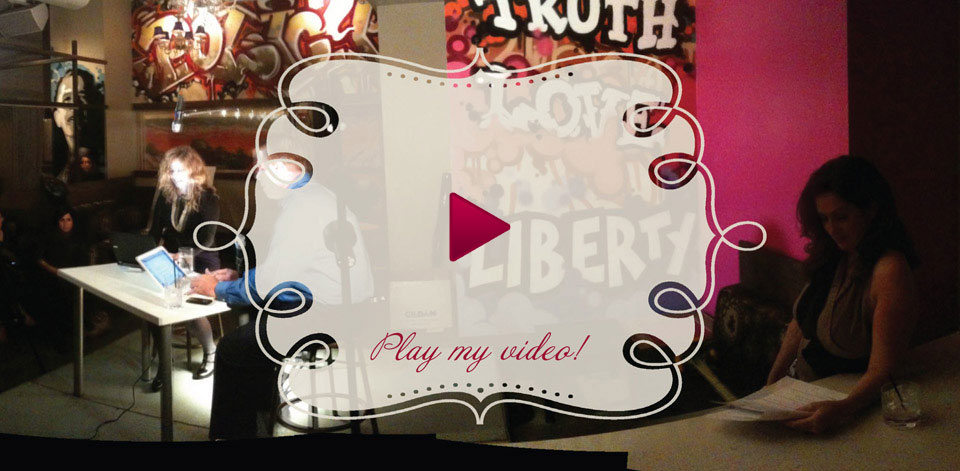
I was honored to be part of this talented, eclectic group of performers.
On the first warm weekend in May, the streets were busy in Washington DC’s Dupont Circle, an artsy roundel that leads north from the White House and mall area. Loungers at Dupont’s fountain flipped through paperbacks and smoothed sun dresses a stone’s throw from several local bookshops presenting a collage of the local arts scene: poetry, painting, theatre, indie comics.
Hillyer Art Space lay at the end of a quiet avenue of old brick buildings and town-homes flanked by converted stables from the era of the carriage, but the crisp exterior melon and grey paint had transformed it into a unique and inviting venue. People drifting in seemed unaware that they were embarking on something essentially controversial: the culture crime of mixed media mash-up and genre cross-dressing as sponsored by the enablers at Barrelhouse and Big Planet Comics.
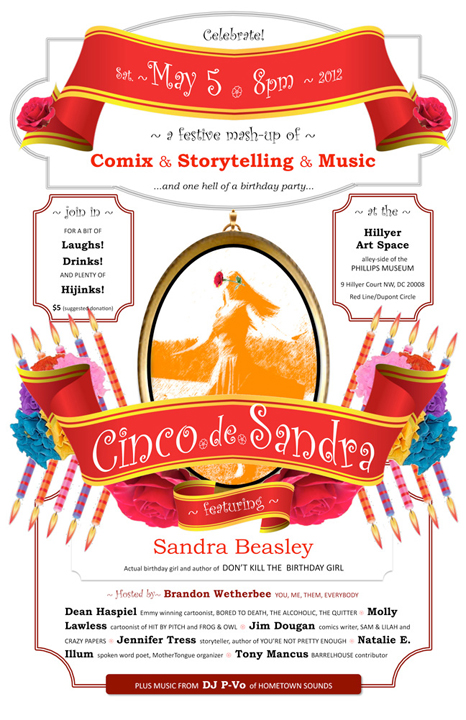
(“Cinco de Sandra” poster designed by Rachel Dougan)
As if everyone attending Sandra Beasley’s off-beat birthday bash were part of this performance “happening”, they seemed to know when it was time to get started, pulling up folding chairs with carefully balanced icy-bottled drinks in hand to collaborate in this conspiracy of genre-bending that would consist of a controlled collision of the audio, the visual, the spoken and the read.
Talk show host and assistant editor at The Huffington Post DC, Brandon Wetherbee, set the 21st century tone by encouraging us to tweet our satirical comments at performers while appearing to listen respectfully while he directed the flow of the multimedia experience.
Comics writer and ACTIVATE contributor Jim Dougan was our first offender, delivering a brutal zinger of a reflective comic on the tokens of manhood honored in suburban life as illustrated by Roger Langridge. Jim immediately set a challenging tone for the techno-performance gathering by using “activated” projected panels that appeared for emphasis. He returned later with “How I Lost My S#?! at the Apple Store,” illustrated by fellow performer Molly Lawless, recounting the slow build of consumer aggro that led to a violent, shaming outburst in an Apple Store, a shout no doubt heard around the world.
Dean Haspiel and Jen Ferguson immersed us in Dean’s “The Last Romantic Antihero” in full-panel spread with blocks of bold color, appearing almost cinematic against the projected white back wall where they took their place in the line-up. The shocking apocalyptic images of the Billy Dogma tale were particularly brought home in this venue introducing the urban hell and desert decay of literal and figurative social disconnection. Was this subversive gathering itself some form of antidote for the myopic “what about me?” of the narrative. Dean also intoned a first reading of his prose “I’d Rather Be Happy Than Right” from the Trip City Visitor’s Guide 2012 heralding the reckoning of self-knowledge often conveyed to us by others in a world where we might be a little too sure that “everything has its place,” art forms included.
Tony Mancus, established poet and publisher, charged the stage next with his bold elliptical circumnavigation of cultural allusion and internal experience in verse, suggesting the raucous descent of a rollercoaster with the requisite exhilaration of observing the world crash by before stumbling away from the near-wreck of language. He verbally painted the portrait of a modern man, excoriated the ravages of punctuation, and insisted on the predatory nature of poetry “very aware of itself.”
Comics creator and graphic novelist Molly Lawless brought us “repressed memory theatre” concerning the humiliations of parental humor, also using cued sliding frames and mobile textbox commentary to plumb the Hadean depths of the “defective gene” of Boston Red Sox fans losing their faith in “miracles.” Stunning nostalgic style led us deep into the ephemera of childhood and adolescence, but shed a particular light on the conflict-generating parent-child relationship from the perspective of the reflective adult.
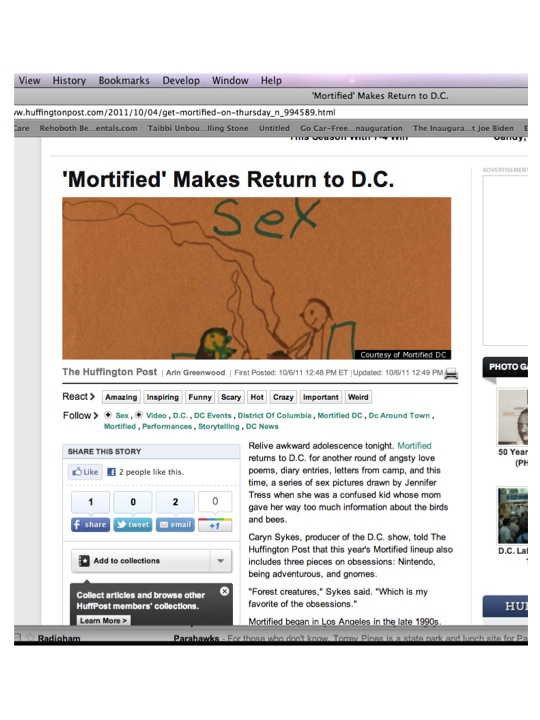
Writer and Huffington Post contributor Jennifer Tress reported on her younger self with a series of child-drawn slides gleaned from family archives kept by “hippie parents” who had no compunction carefully explaining the nitty gritty science of procreation to a four year old expecting a new sibling. The illustrated “sex papers” she drew at the time created a window on the visual nature of mental processes, and reinforced an ongoing theme of looking back from an altered, quizzical perspective on youthful reactions to the strange and unexpected.
Meanwhile, the irrepressible Wetherbee broke into a discussion of another “live” art as life performance, Rue Paul’s Drag Race and the virtues of loving yourself. It might have just as easily been a commentary on the meaningfully transgressive combinations of self-expression taking the stage at “Cinco de Sandra.”
Veteran performance poet and writer Natalie E. Illum introduced the concept of “body poems” in tightly intertwined phrases with an unpredictably recursive quality, re-evaluating previous statements and undercutting their meaning into new forms. Natalie’s performance style electrified the room, springing between clipped enunciation of the “hope chest” of the body to the more flowing interleaved card-tricks of “chance,” again hinting at the impact of earlier generations on the ongoing premises of our generation.
Guest of honor, Trip City contributor, and laurelled poet Sandra Beasley, the birthday girl of 5/5 (we tried not to kill) was up last, and seemed to embody the nature of the event’s combined geography as someone with both New York and DC connections, traveling between them and all points with her “heart in a suitcase.” Sandra poked fun at our own intrinsic anachronisms from the perspectives of our future selves, and the “ridiculous” activities we perform in search of the individual “verandahs” where we hope to affirm our own “calling.” The first live reading of Beasley’s Trip City published “Hunger: (a sextina),” which had been daring in its metaphors for desire in print, was exuberantly irreverent in spoken word.
Jim Dougan, one of the event’s organizers who also has close ties to New York but resides in DC, commented afterward that he “wanted everyone who performed to have the chance to put their best foot forward and strut their stuff, and for everyone who came to be really entertained.” I watched the interaction of disparate artistic creators to the tunes of Paul Vodra, a.k.a DJ P-Vo, who provided our grounded musical subtext for the exploration of live artistic experience, and concluded that Dougan had gotten his wish. Something surprisingly unlikely and well beyond the status quo of established art genres had been achieved at “Cinco de Sandra” via the pageantry of performance; it was time to celebrate.
– Hannah Means-Shannon for Trip City
![[Rob Wittman]](http://www.contactingthecongress.org/pictures/VA01.jpg)
![[Gerald E. (Gerry) Connolly]](http://www.contactingthecongress.org/pictures/VA11.jpg)
![[Bobby Scott]](http://www.contactingthecongress.org/pictures/VA03.jpg)
![[Bob Goodlatte]](http://www.contactingthecongress.org/pictures/VA06.jpg)
![[Jim Moran]](http://www.contactingthecongress.org/pictures/VA08.jpg)
![[Frank R. Wolf]](http://www.contactingthecongress.org/pictures/VA10.jpg)
![[Scott Rigell]](http://www.contactingthecongress.org/pictures/VA02.jpg)